Why negative heights appear, and why they aren’t calculation errors
You substitute the values. The maths works.
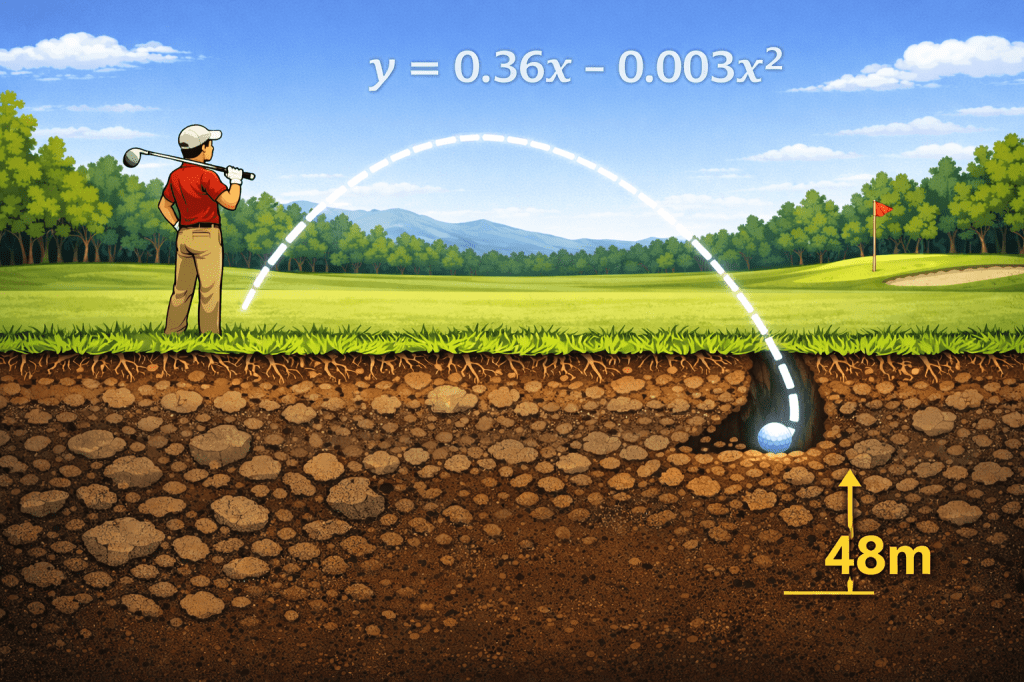
Then the answer says the golf ball is 48 metres below the ground.
That’s usually when students stop and think: “Why am I getting a negative height?”
Illustration showing a mathematical model predicting a golf ball below ground, representing negative height in A-Level Mechanics
In exam questions, this often appears alongside a line like:
Comment on the validity of the model.
It feels like an algebra mistake, but it isn’t! The maths is doing exactly what it should. The problem is something else.
So What Is Going On?
The equation looks flawless. The numbers come out neatly.
So under pressure, it’s very natural to assume: If I’m given a value of , I’m meant to substitute it.
That instinct is usually correct, however…
A mathematical model doesn’t know anything about golf balls, gravity, or the ground. It will happily keep producing outputs long after the real situation it represents has stopped making sense.
The mistake isn’t using the model. The mistake is forgetting when it stops describing reality.
That’s exactly what examiners are testing when they ask about validity.
What This Looks Like In Practice
Suppose the height of a golf ball is modelled by
where:
is the height above the ground (in metres)
is the horizontal distance travelled (in metres)
This is an upside-down quadratic. That already tells us something important: the ball goes up, reaches a maximum height, then comes back down.
To find when the ball hits the ground, we set the height equal to zero:
Factorising:
This gives two solutions:
These aren’t just numbers. They have meaning.
the ball starts on the ground
the ball lands back on the ground
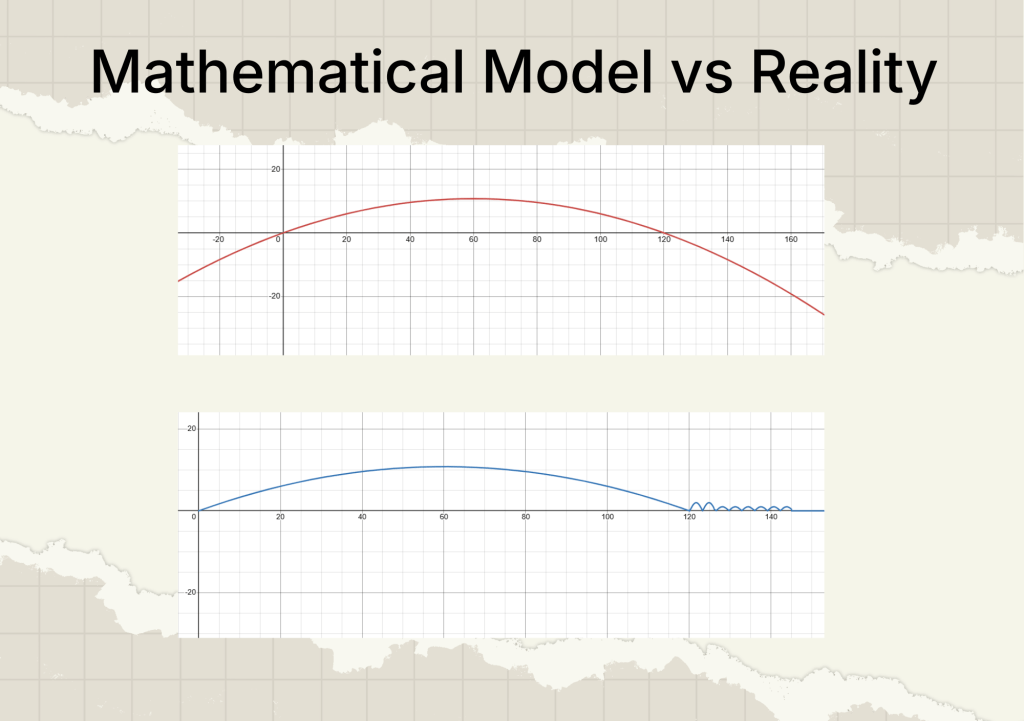
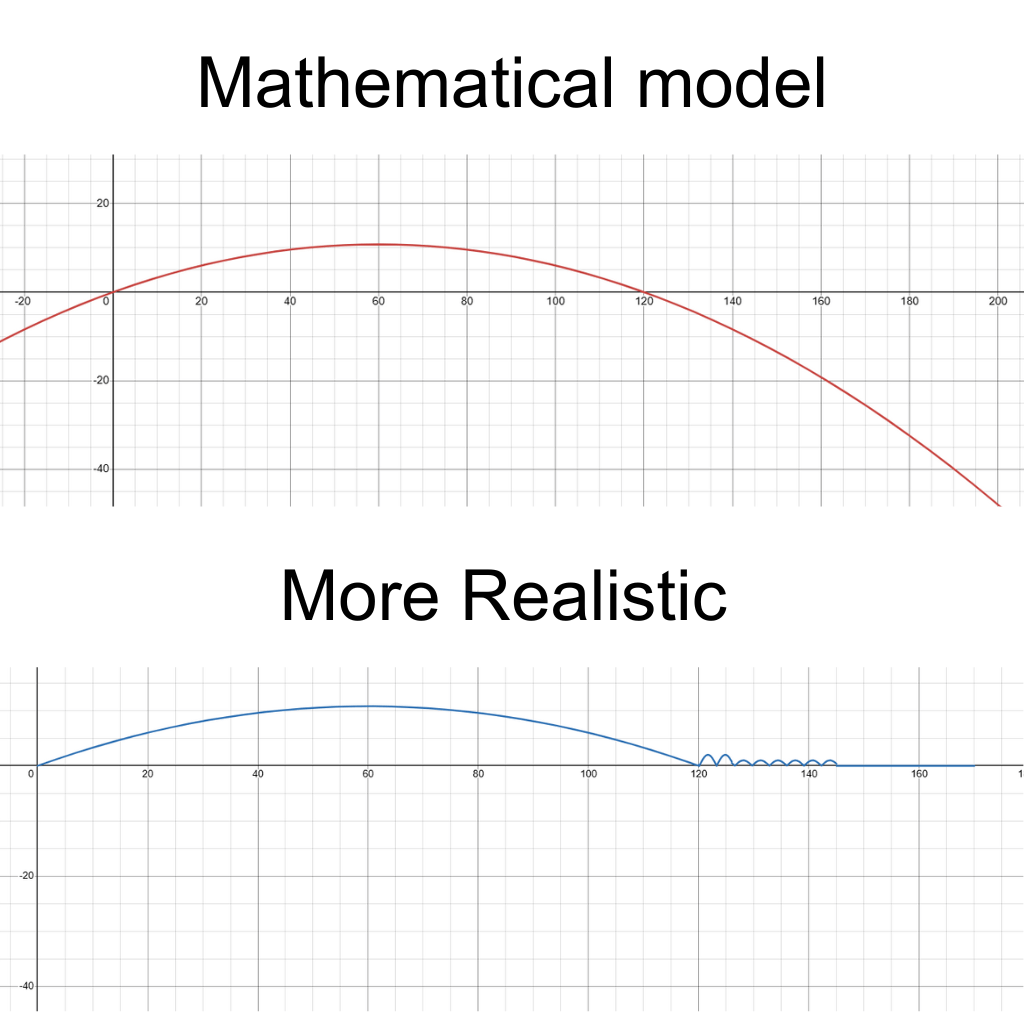
So the model describes the flight of the ball only between 0 and 120 metres.
That interval matters more than the formula itself.
A Worked Example (Where Things Usually Go Wrong)
Now suppose you’re asked:
Use the model to predict the height of the golf ball when it is 200 metres from the golfer.
The model is now predicting a height below the ground, which tells you something crucial: the model is being used outside its valid range.
The ball has already landed at 120 metres. Beyond that point, the original situation “a golf ball in flight” no longer exists.
The negative height isn’t an error. It’s a warning sign.
The Key Takeaway
A model will always give an output, even when it no longer represents reality.
Solving tells you where the model starts and stops being valid, not just where the maths works.
Values outside that range can be algebraically correct while being physically meaningless.
So when you’re asked to comment on validity:
Does this result still make sense in the real situation being modelled?
If This Still Feels Hard…
If this topic feels more confusing than expected, it’s usually because of gaps in:
Interpreting solutions in context (what answers mean, not just what they are)
Understanding quadratics as shapes, not just formulas
Linking graphs to real-world behaviour
Knowing when substitution is appropriate, and when it isn’t
Once you tighten up on these, applying them becomes easier.
Final Thought
Mathematical models are powerful precisely because they simplify reality, but that simplification always comes with limits.
When an answer feels “wrong”, it’s often because the maths has quietly gone past the point where the real situation still applies. Learning to spot that moment is what separates calculation from understanding.
And once you see it, questions like these stop feeling weird and start making sense.
 Cleerelearn