Author: callumcleere123

  • Why Do You Multiply Probability by the Total?

    You’re in the middle of a probability question and it says something like:

    The probability of rolling a 6 is 0.3.
    The dice is rolled 200 times.
    Estimate how many times it lands on 6.

    And everyone (including your teacher) immediately does this:

    0.3 × 200

    …and somehow gets the answer.

    But if you’re thinking:

    “Why are we multiplying? Where did that come from?”

    Good. That question is the difference between copying a method and actually understanding probability.

    Let’s make it make sense.

    The idea: probability is “out of 1”, frequency is “out of lots”

    A probability is basically saying:

    “Out of 1 attempt, what fraction of the time would this happen?”

    So if the probability is 0.3, that means:

    “This should happen about 30% of the time.”

    Now if you don’t do it once…
    You do it 200 times

    You’re asking a different question:

    “If it happens 30% of the time, how many times is that out of 200?”

    That’s why we multiply.

    A simpler example first: coins

    If you flip a fair coin:

    • Probability of tails = 0.5
    • If you flip it 200 times, how many tails should you expect?

    Half of 200 is 100.

    So you do:

    0.5 × 200 = 100

    That multiplication isn’t random.

    The rule (this is the whole topic)

    If something has probability pp
    and you try it nn times,

    then the estimated number of times it happens is:

    expected frequency (or relative frequency) = probability × total trials

    Back to the dice question

    Probability of a 6 = 0.3
    Number of rolls = 200

    So the estimate is:

    0.3 × 200 = 60

    Meaning:

    If you rolled this biased dice 200 times, you’d expect about 60 sixes.

    Not guaranteed. Just the best estimate.

    Why this works (the “feel” for it)

    Think of it like this:

    • Probability tells you the “rate”
    • Total tells you “how many chances you have”
    • Multiply them to get “how many hits you expect”

    It’s the same logic as:

    “If 30% of the class is left-handed, and there are 200 students… how many left-handed students would you expect?”

    Same exact maths.

    Quick check you can do in your head

    Before you even calculate, do this:

    • 0.3 is about a third
    • a third of 200 is about 66
    • so the answer should be somewhere around 60–70

    So 60 makes sense.

    This is how you stop silly mistakes.

    Final thought

    You multiply probability by the total because:

    Probability is a proportion.
    The total tells you how many chances you have.
    Multiplying applies the proportion to the total.

    That’s all relative frequency really is:
    turning probability into an estimate.
  • Integration Sounds Complicated Right? But It Isn’t. Here’s Why.

    Calculus has a reputation.

    People hear the word and immediately think, that is for geniuses, not me…

    Most students switch off before they’ve even seen a question.

    Which is a shame… because at its core, calculus is actually very simple.

    Let me show you.

    Let’s explain calculus simply

    Imagine you want to find the area of a rectangular field.

    Easy, right?

    If it’s a rectangle, you just do:
    length × width
    Done.

    No stress.

    Well… what if the field isn’t straight?

    Now suddenly:

    • length × width doesn’t work

    This is the point where most people think:

    Yeah imma skip this one.

    But here’s the key idea.

    The First Clever Thought

    Even though the shape is curved…

    It kind of looks like a rectangle.

    So you could approximate it.

    You could say:
    “Alright, it’s not perfect, but I’ll use a rectangle that roughly fits.”

    Is that accurate?
    Not really.

    Is it better than nothing?
    Yes.

    The Second, Better Thought

    Instead of one big rectangle…

    What if you use lots of small rectangles?

    Now they fit the curve better.

    The more rectangles you use:

    • the closer you get to the real shape
    • the better your estimate becomes

    Already, you’re doing calculus thinking, without realising it.

    The Main Idea

    Now push that idea further.

    What if the rectangles became:

    • thinner
    • and thinner
    • and thinner…

    So thin that they are almost lines.

    And you used infinitely many of them.

    Now you are no longer approximating.

    You are exactly matching the curve.

    And when you add up all those tiny pieces…

    You get the exact area.

    That’s it.

    That is calculus.

    So What Is Calculus, Really?

    At its core:

    Calculus is just adding up really small things to get an exact result.

    That’s it.

    No mystery.
    No magic.
    No genius-only maths.

    Just:
    small pieces → added together → to make something precise.

    Why Students Find It Hard Even Though It Isn’t

    The problem is not the idea.

    The problem is that students are usually shown:

    • symbols first
    • rules first
    • notation first

    Before they’re ever shown what it’s actually doing.

    So it feels abstract.
    Disconnected.
    Pointless.

    Once you see the why, the mechanics make sense.

    Final Thought

    Calculus isn’t complicated.

    It’s just badly introduced.

    And once you understand that it’s really about:

    breaking things into tiny pieces and adding them up

    it stops being scary.

    And starts being logical.

  • How Do I Know Which SUVAT Equation to Use.

    You probably know the SUVAT equations.
    You probably know how to substitute into them.

    But in an A level exam, with those long, messy mechanics questions, it’s very easy to sit there thinking:

    “Which SUVAT equation do I use here?”

    And then the guessing starts.

    You’re not bad at maths. There is a simple way to deal with it.

    The mistake most students make

    Most students look at the list of equations and think:

    “Which one looks right? – Vibes it…”

    You don’t start with equations.
    You start with the information the question gives you.

    The method that actually works

    First, write out the letters:

    S (Displacement)
    U (Initial Velocity)
    V (Final Velocity)
    A (Acceleration)
    T (Time)

    Now go through the question and write down which letters you know the value for.

    For example:

    • if it says “starts from rest”, then u = 0
    • if it takes 5 seconds, then t is known
    • if it is accelerating, then a is known

    List the letters you have.

    Finally, don’t forget the letter you are looking for. For example, if we are looking for the final velocity, we also list v.

    The Five SUVAT Equations

    1. v = u + at
    2. s = ut + ½at²
    3. s = vt − ½at²
    4. v² = u² + 2as
    5. s = (u + v) / 2 × t

    We can now look at which equation contains all 4 letters we listed.

    v = u + at

    The first equation contains all our letters, so we pick this one!

    That’s it

    That’s the whole method.

    Write the letters.
    List what you know.
    Include what you’re finding.
    Pick the equation that contains all four.

    Once you do it this way, SUVAT stops feeling random and starts feeling controlled.

    And that’s exactly what you want in an exam.

  • Why Does My Child Struggle With Maths Exams But Not In School or at Home?

    Your child seems fine in lessons.
    Homework gets done.
    They can explain things out loud.

    Then the test results come back and they don’t reflect any of that.

    This is one of the most common concerns parents raise:

    “My child can do it at home and in school, so why don’t the results show it?”

    It’s tempting to assume something must be wrong with ability, confidence, or effort.

    In most cases, it isn’t any of those.

    The key difference isn’t intelligence it’s how maths is tested

    In school, children are usually taught methods.

    For example:

    • how to add fractions
    • how to multiply
    • how to use the column method

    And when they’re asked directly to do those things, many children are fine.

    If you put in front of them:

    Add 27+16\frac{2}{7} + \frac{1}{6}

    they may be able to do it — especially if they’ve practised that method.

    But most maths tests (especially SATs, 11+ and GCSE’s) don’t stop there.

    Where tests are harder than Lessons

    Instead of asking what to do, tests often ask children to work out what needs to be done.

    For example:

    Jonathan eats two-sevenths of a cake.
    Lena eats one-sixth of the same cake.
    How much of the cake is left?

    Mathematically, this still involves adding fractions.

    But cognitively, it’s much harder.

    Now the child has to:

    • read carefully
    • decide what the maths actually is
    • remember the method
    • carry it out
    • realise they then need to subtract from one

    That’s a lot going on at once, especially for a Year 5 or Year 6 child.

    “But they know how to add fractions…”

    This is the most frustrating part, they do know how!
    They just haven’t been trained to recognise when to use it.

    This is why parents often say:

    “If you tell them what to do, they can do it.”

    That’s true, and also the problem.

    Why this affects maths more than English

    English is more fluid.

    Children read, write, talk, and interpret language every day. Even when they’re unsure, they can often have a go.

    Maths doesn’t feel like that.

    When a child sees a maths question they don’t immediately recognise, they often think:

    “I don’t know this.”

    Not:

    “I need to work out what this is asking.”

    Once that thought kicks in, confidence drops quickly.

    And maths is very unforgiving emotionally, answers are right or wrong, and children know it instantly.

    Why getting stuck destroys confidence

    In class, children rarely feel “stuck” when practising methods.

    They might make a mistake, but they still know what step comes next.

    Problem-solving questions are different.

    They create a pause.
    A moment of uncertainty.
    A feeling of not knowing where to start.

    Many children interpret that moment as:

    “I can’t do maths.”

    Even though what’s really happening is:

    “I haven’t seen this type of question before.”

    Why this issue shows up in SATs, 11+ and GCSE papers

    In primary school tests:

    • Paper 1 is arithmetic (straight calculations)
    • Papers 2 and 3 are problem solving and reasoning

    It’s very common for children to do well in arithmetic but struggle badly in the other two papers.

    That doesn’t mean they’re weak at maths.

    It means they haven’t had enough exposure to:

    • unfamiliar questions
    • questions where the maths is hidden
    • questions that require thinking before calculating

    The fix is simpler than most parents expect

    This usually isn’t about learning more maths.

    It’s about:

    • seeing lots of different question styles
    • becoming comfortable with uncertainty
    • learning that being stuck doesn’t mean being incapable

    Past papers help enormously, not because they’re magic, but because they:

    • normalise problem-solving
    • reduce panic
    • build confidence through familiarity

    The most important thing for parents to know

    If your child struggles with maths exams, it does not mean:

    • they aren’t logical
    • they aren’t capable
    • they “just aren’t a maths person”

    It usually means they’re being tested on application, not recall and that shift hasn’t been made clear to them yet.

    That’s a teaching gap, not an ability gap.

    Final thought

    Maths becomes difficult not when the numbers get harder but when the thinking changes and no one explains that change.

    Once children understand that maths tests are asking them to decide what to do, not just do it, a lot of the fear starts to disappear.

    And confidence comes back surprisingly fast.

    Leave a comment

  • What Does “Comment On The Validity of a Model” Mean in A Level Mechanics

    What Does “Comment On The Validity of a Model” Mean in A Level Mechanics

    Why negative heights appear, and why they aren’t calculation errors

    You substitute the values.
    The maths works.

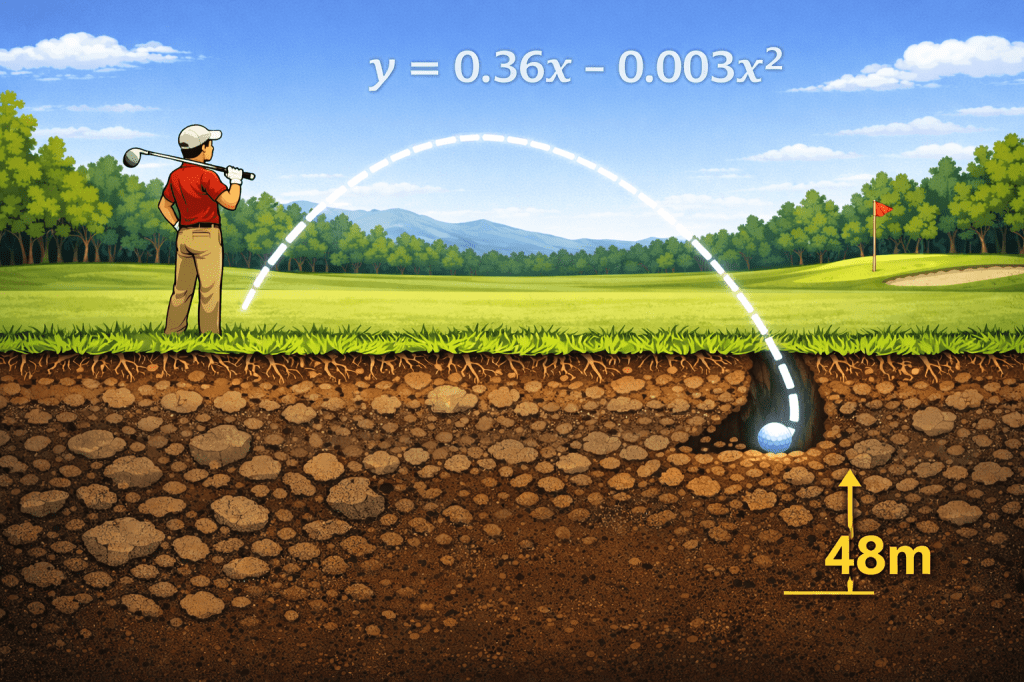
    Then the answer says the golf ball is 48 metres below the ground.

    That’s usually when students stop and think:
    “Why am I getting a negative height?”

    Illustration showing a mathematical model predicting a golf ball below ground, representing negative height in A-Level Mechanics

    In exam questions, this often appears alongside a line like:

    Comment on the validity of the model.

    It feels like an algebra mistake, but it isn’t! The maths is doing exactly what it should. The problem is something else.

    So What Is Going On?

    The equation looks flawless.
    The numbers come out neatly.

    So under pressure, it’s very natural to assume:
    If I’m given a value of xx, I’m meant to substitute it.

    That instinct is usually correct, however…

    A mathematical model doesn’t know anything about golf balls, gravity, or the ground. It will happily keep producing outputs long after the real situation it represents has stopped making sense.

    The mistake isn’t using the model.
    The mistake is forgetting when it stops describing reality.

    That’s exactly what examiners are testing when they ask about validity.

    What This Looks Like In Practice

    Suppose the height of a golf ball is modelled by

    h=0.36x0.003x2h = 0.36x – 0.003x^2

    where:

    • hh is the height above the ground (in metres)
    • xx is the horizontal distance travelled (in metres)

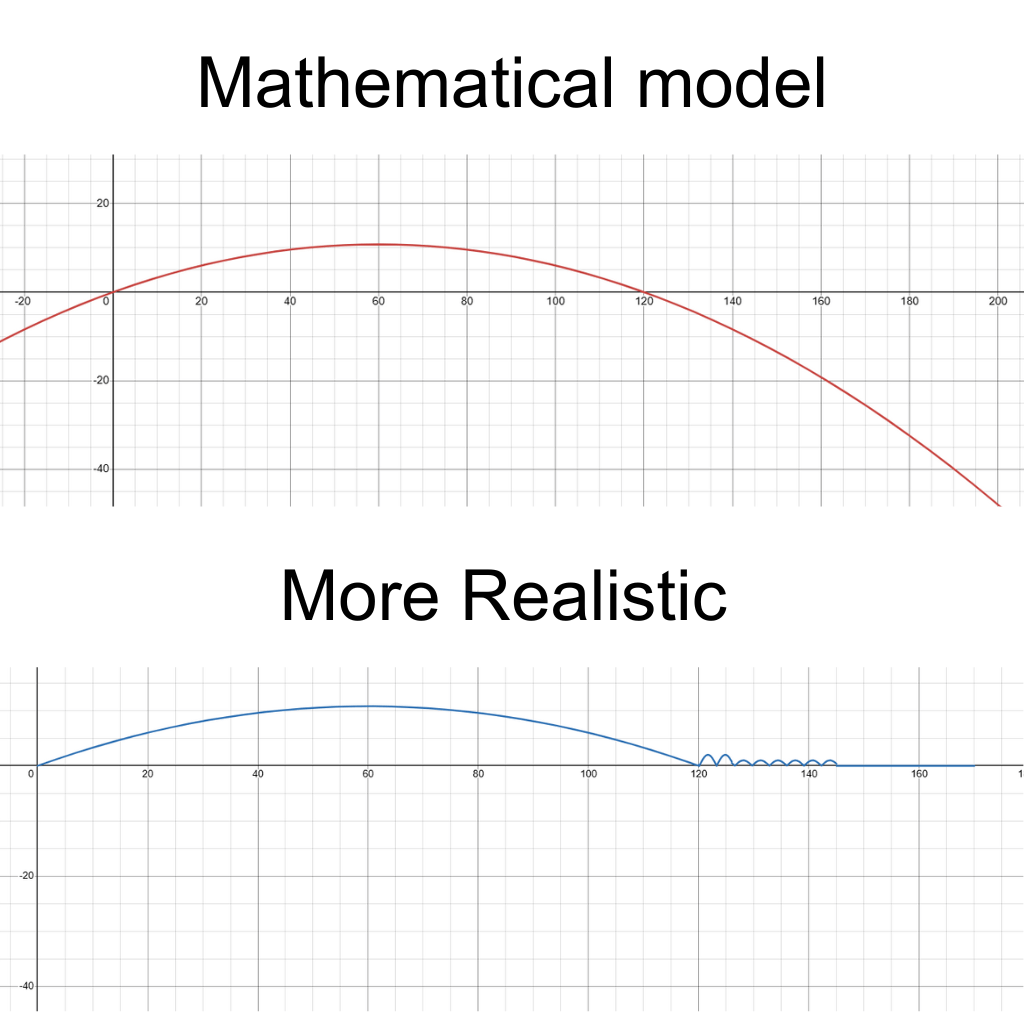
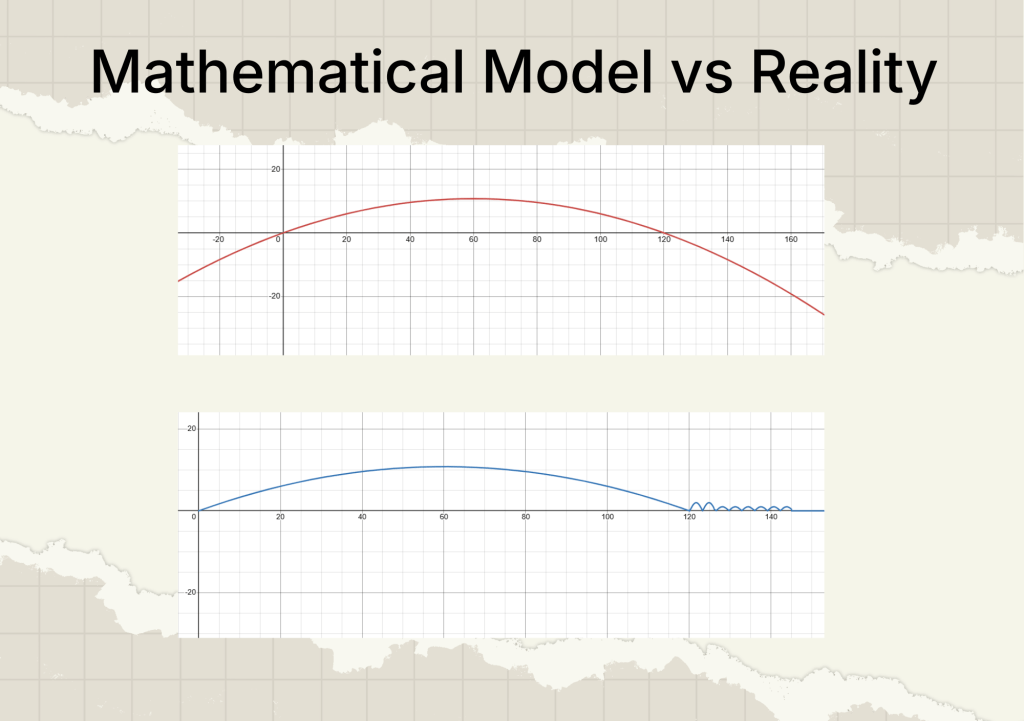
    This is an upside-down quadratic. That already tells us something important: the ball goes up, reaches a maximum height, then comes back down.

    To find when the ball hits the ground, we set the height equal to zero:

    0=0.36x0.003x20 = 0.36x – 0.003x^2

    Factorising:0=x(0.360.003x)0 = x(0.36 – 0.003x)

    This gives two solutions:

    • x=0x = 0
    • x=120x = 120

    These aren’t just numbers. They have meaning.

    • x=0x = 0 the ball starts on the ground
    • x=120x = 120 the ball lands back on the ground

    So the model describes the flight of the ball only between 0 and 120 metres.

    That interval matters more than the formula itself.

    A Worked Example (Where Things Usually Go Wrong)

    Now suppose you’re asked:

    Use the model to predict the height of the golf ball when it is 200 metres from the golfer.

    If you substitute x=200x = 200

    h=0.36(200)0.003(200)2=72120=48h = 0.36(200) – 0.003(200)^2 = 72 – 120 = -48

    Mathematically? Perfectly correct.
    Physically? Impossible.

    This is the point examiners care about.

    The model is now predicting a height below the ground, which tells you something crucial:
    the model is being used outside its valid range.

    The ball has already landed at 120 metres. Beyond that point, the original situation “a golf ball in flight” no longer exists.

    The negative height isn’t an error.
    It’s a warning sign.

    The Key Takeaway

    1. A model will always give an output, even when it no longer represents reality.
    2. Solving h=0h = 0 tells you where the model starts and stops being valid, not just where the maths works.
    3. Values outside that range can be algebraically correct while being physically meaningless.

    So when you’re asked to comment on validity:

    Does this result still make sense in the real situation being modelled?

    If This Still Feels Hard…

    If this topic feels more confusing than expected, it’s usually because of gaps in:

    • Interpreting solutions in context (what answers mean, not just what they are)
    • Understanding quadratics as shapes, not just formulas
    • Linking graphs to real-world behaviour
    • Knowing when substitution is appropriate, and when it isn’t

    Once you tighten up on these, applying them becomes easier.

    Final Thought

    Mathematical models are powerful precisely because they simplify reality, but that simplification always comes with limits.

    When an answer feels “wrong”, it’s often because the maths has quietly gone past the point where the real situation still applies. Learning to spot that moment is what separates calculation from understanding.

    And once you see it, questions like these stop feeling weird and start making sense.